The Christmas story has provided inspiration for artists through the ages and some of these images have shaped how we see these passages.
There are many references in the Bible to angels – one of these is the appearance of the angel Gabriel to Mary - The Annunciation.
Luke 1:26-28
In the sixth month of Elizabeth's pregnancy, God sent the angel Gabriel to Nazareth, a town in Galilee, to a virgin pledged to be married to a man named Joseph, a descendant of David. The virgin’s name was Mary. The angel went to her and said, ‘Greetings, you who are highly favoured! The Lord is with you’.
Here are 2 contrasting images of the Annunciation. The first “The Annunciation” is by Fra Filippo Lippi, an Italian painter born about 1406 in Florence which can be seen at the National Gallery in London. The 2nd picture, The Annunciation (1898), is by Henry Ossawa Tanner. Tanner was the son of a minister in the African Methodist Episcopal Church and specialized in religious subjects.
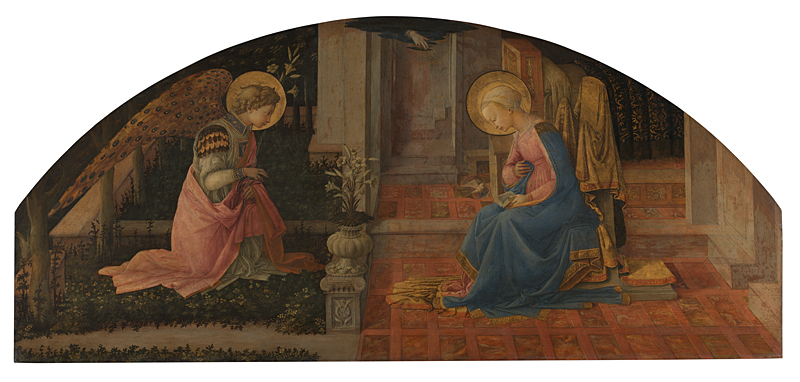
In this beautifully symmetrical depiction of the Annunciation, the angel Gabriel is shown on the left with peacock feather wings kneeling in front of the Virgin Mary, his head bowed in reverence. At the top of the picture the hand of God can be seen sending the Holy Spirit in the form of a dove towards the Virgin’s belly. A golden light emanates from a gap in Mary’s pink dress and she bows her head towards it, in acceptance.
The picture comes from a palace belonging to the Medici, Florence’s ruling family at the time, where it most probably hung above a door. Below the central urn containing lilies, a symbol of Mary’s purity, is a carving of three feathers inside a diamond ring. This was an emblem adopted by several members of the Medici family.
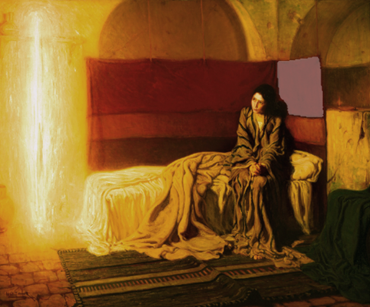
This picture was painted soon after Tanner returned from a trip to Egypt and Palestine in 1897. Influenced by what he saw, he created an unconventional image of the moment when the angel Gabriel announces to Mary that she will bear the Son of God. Mary is shown as an adolescent dressed in rumpled Middle Eastern peasant clothing, without a halo or other holy attributes. Gabriel appears only as shaft of light. Tanner entered this painting in the 1898 Paris Salon exhibition, after which it was bought for the Philadelphia Museum of Art in 1899.